Objects That Earn Their Place: How to Build a Home with Slow Decor and Intentional Living
Share
There's a particular kind of room that stops you. Not because it's perfectly styled or freshly decorated, but because it feels like someone actually lives there. Like the objects chose the people as much as the people chose them.
I've been thinking about that a lot lately. We moved into our house not long ago and it still doesn't feel entirely like ours. There are corners that feel uncertain, walls that haven't found their thing yet. But slowly, piece by piece, moving things around, living with what we have, it's getting there. And that process, the slow revealing of a home, has taught me more about intentional interiors than any mood board ever has.
Because here's what I've noticed. The rooms that feel the richest, the most layered and personal, are never the ones that were finished all at once.
The Problem with More
We've started to confuse personality with accumulation. More pieces, more prints, more carefully sourced objects, until suddenly the room doesn't feel soulful or collected. It just feels busy.
I understand how it happens. We want our homes to feel like something. We want to walk through the door and exhale.
But slow decor isn't about adding more with intention. It's about understanding that the most meaningful things in a home are usually already there. Or they arrive quietly, without fanfare, and simply stay.
The Objects That Have Always Been There
My favourite piece in our home is a loose painting of my uncle Mic fishing. I don't know exactly when my dad painted it. I just know it's been on our walls for as long as I can remember, in childhood, in other houses, and now here. It didn't come from a gallery or a carefully curated interiors edit. It came from life.
That's what intentional home decor actually looks like, most of the time. Not a considered purchase. A painting that followed you here.
My dad's landscape photography hangs alongside his seascape paintings. Movie posters we love, properly framed, given wall space without apology. Vinyl albums gathered over years of trips to record shops in Brighton and other small music towns, displayed not as decoration but as a kind of autobiography.
None of these things were bought for the room. They were brought into the room because they're part of who we are. That's the difference.
Slow decor isn't a style. It's an accumulation of a life, edited carefully and placed with care.
Not Everything Meaningful Needs to Be on Display
There's a version of intentional living that tips into severity. The idea that if it doesn't spark joy in a very specific and immediate way, it shouldn't exist in your home at all. I don't believe that.
But I also think we sometimes underestimate what certain objects can become when we treat them differently.
A silk scarf you love, really love, the kind you bought because the print stopped you, doesn't have to live folded in a drawer or worn only occasionally. Frame it. Put it on the wall. A beautifully illustrated scarf behind glass becomes something else entirely.
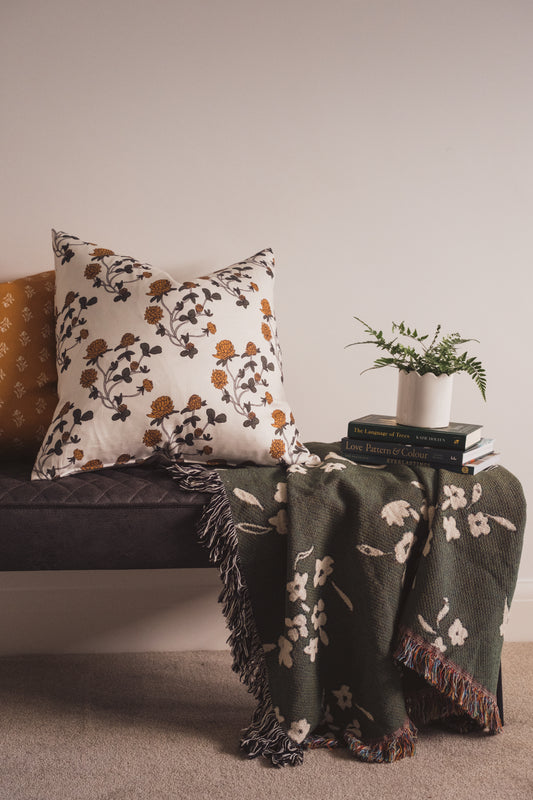
A vintage blanket, or a woven throw with real texture and history, hung on a wall or draped over a ladder does more for a room than most prints you could buy.
And a photo album, a real one, printed and bound, on your coffee table does something a styled interiors book never quite can. It holds your actual life. It's the most personal thing in the room.
The question isn't whether something is beautiful enough to be out. It's whether you're seeing it properly.
Meaningful Objects Have a Story You Can Tell in One Sentence
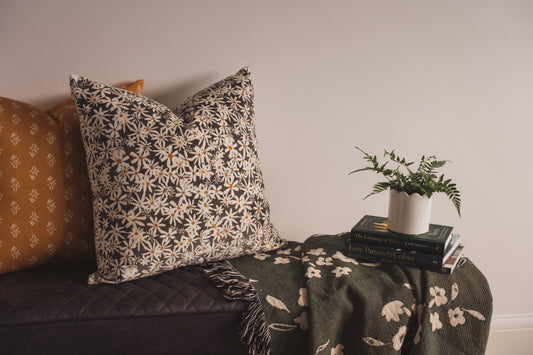
The Daisy design, the one on the cushion in my office and the tea towel in the kitchen, started as a gift. A friend who loved daisies. I painted it for her, printed it on a scarf and a little notebook, wrapped it up. I love this print for a lot of reasons. Because daisies remind me of my grandmother Lil, who loved them too. Because there's something in the act of making something for someone, a particular kind of care that gets into the work and stays there. It holds more than it looks like it holds. That's the thing about objects with a story behind them. They carry it quietly.
That's what I mean when I talk about slow decor and intentional interiors. Not that every object needs a long provenance or a sentimental history. But the pieces that earn their place tend to have at least one true sentence behind them.
My dad painted this.
We found this at a market on our anniversary.
This was hers.
I saved up for this for months and it was worth every penny.
If you can say something true about a piece in a single sentence, it already holds more meaning and intention than a hundred things you can't.
The Quiet Before the Day Begins
Some mornings, when there's time, I light a candle before anyone else is awake. Kettle on, bare feet on the kitchen floor, tea in hand, the garden just beginning to catch the light. The Daybreak candle. Neroli and petitgrain and lavender, clean and bright and unhurried. It's not just about the scent. It's what the flame does to the room. The way it shifts the quality of the morning, makes it feel chosen rather than just arrived at. A signal, almost. This is yours. This hour, before the day fills it, is yours.
That's how you know a room is working. Not when it photographs well. When it holds a feeling.
Scent is one of the most underused tools in slow home design. The wooden wick burning, wax melting, neroli lifting into the room — it does something to a space that no amount of styling can. It's the difference between a room that's been arranged and one that's actually inhabited.
The same is true of texture. Of light. Of whether the things on your shelves are there because you put them there deliberately or because you haven't gotten around to moving them.
Editing Is the Work
Good editing is usually just good styling in disguise.
I've moved things around our new house more times than I can count. The uncle Mic painting has been in three rooms. Some things that felt right in the old house feel wrong here. Some things I wasn't sure about have found exactly the right wall and now I can't imagine them anywhere else.
This is the work of intentional home decor. Not buying the right things, though that matters too. Living with what you have long enough to understand where it wants to be.
Before you buy anything new for a room, move three things. Remove two. Sit with the space for a few days. Most rooms don't need more. They need the things that are already there to be seen properly.
The homes that feel the most layered, the most personal and at ease, are never the ones that were finished quickly. They're the ones where someone has been paying attention for years.
On Getting There, Slowly
Our house is still becoming itself. There are corners I haven't solved yet and a wall that's been bare since we moved in because nothing has felt right for it. I've stopped trying to force it.
That's the thing about slow decor and intentional living. It asks for patience. It asks you to wait for the piece that feels true rather than filling the space with something that merely fits.
The most beautiful homes I've ever been in have all had that quality. The feeling that every object earned its place. That nothing was there by accident. That the people who lived there had been paying attention for a long time.
That's what I'm working towards.