Behind the Pattern: Clover
Share
The story behind the clover pattern
On botanical drawing, a half-remembered afternoon, and a pattern that took its time
Some designs arrive fully formed. Others take their time - gathering pieces from different places, different moments, until they finally come together.
The clover pattern was the second kind.
Where it started
I'd been learning botanical drawing. Not formally - just following my curiosity, studying historic patterns, looking closely at how artists from earlier centuries captured plants on paper. The precision of it. The patience.
There's something about botanical illustration that asks you to slow down. You can't rush a leaf. You have to really look - at the veins, the way the edges curl, the exact angle where stem meets petal.
I was drawn to clover for reasons I couldn't quite name at first. It's such a humble plant. Easy to overlook. But the more I drew it, the more I understood why it had stayed with me.
A memory surfaced
Sitting in a field as a child, picking clovers.
Just picking them. Slowly. The sun warm on my back. No rush. Nowhere to be.
I don't remember where it was. I don't remember who I was with or what happened after. But I remember the feeling - that particular quality of unhurried attention that children slip into so easily, and that most of us spend years trying to recover.
The calm of being completely absorbed in something small. An hour passing without once thinking about what you should be doing instead.
That's what surfaced while I was drawing. Not just the plant, but the pace of it.
From sketch to pattern
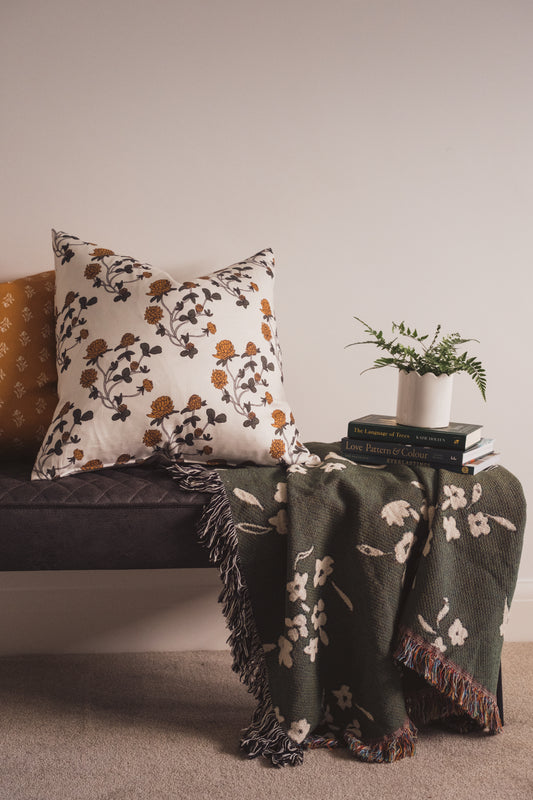
The first drawings were loose. Pencil, then ink, then watercolour washes to find the right tones. I kept coming back to soft ochres and earthy greens - colours that felt warm and grounding rather than bright and demanding.
The clover blooms are deliberately delicate in the final pattern. They're not trying to be the star of the room. They sit quietly, adding texture and calm without asking for attention.
When I designed the bandana version, I added a moss-green stripe. Something to anchor the softness. A little earthy depth.
Where it lives now
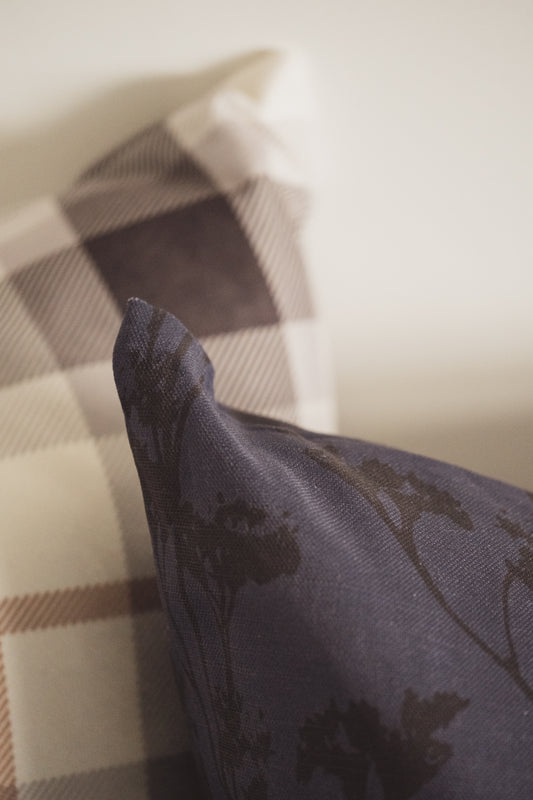
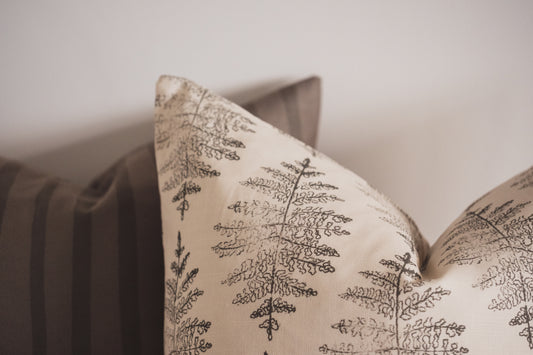
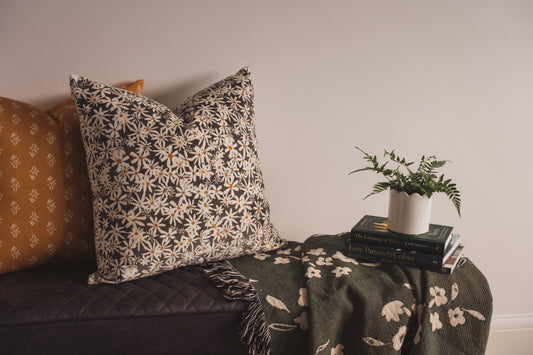
The clover pattern is on cushions - printed on cotton-linen, stuffed with feathers, made to actually be used. On silk bandanas you can wear, tie to a bag, or drape over a bedside table. And now on wallpaper too, for anyone who wants that quiet, clover-filled feeling at a larger scale.
Each version started with the same hand-drawn artwork. The same memory. The same unhurried afternoon in a field I can't quite place.
What it means to me
The clover pattern has become one of my most personal designs.
It's not just a floral. It's a memory I'd lost and found again - a gentle reminder that slowness is still possible, that paying close attention to something small is its own kind of purpose.
I think about that child in the field sometimes. The one who could sit for an hour picking clovers, completely absorbed, no thought of productivity or what came next.
That's rare now. The world moves fast and I move with it, most days. But when I notice this pattern - on a cushion in my living room, on a scarf around my neck - something in me settles. It's a quiet invitation to choose a different pace. To make space for slowness, even briefly.
I'm still learning to move at that pace. But having the reminder helps.
I hope it does the same for you.
If this resonates, you might also enjoy reading about how a tiny shady garden became Lil & Dot — the longer story of where this kind of attention started.